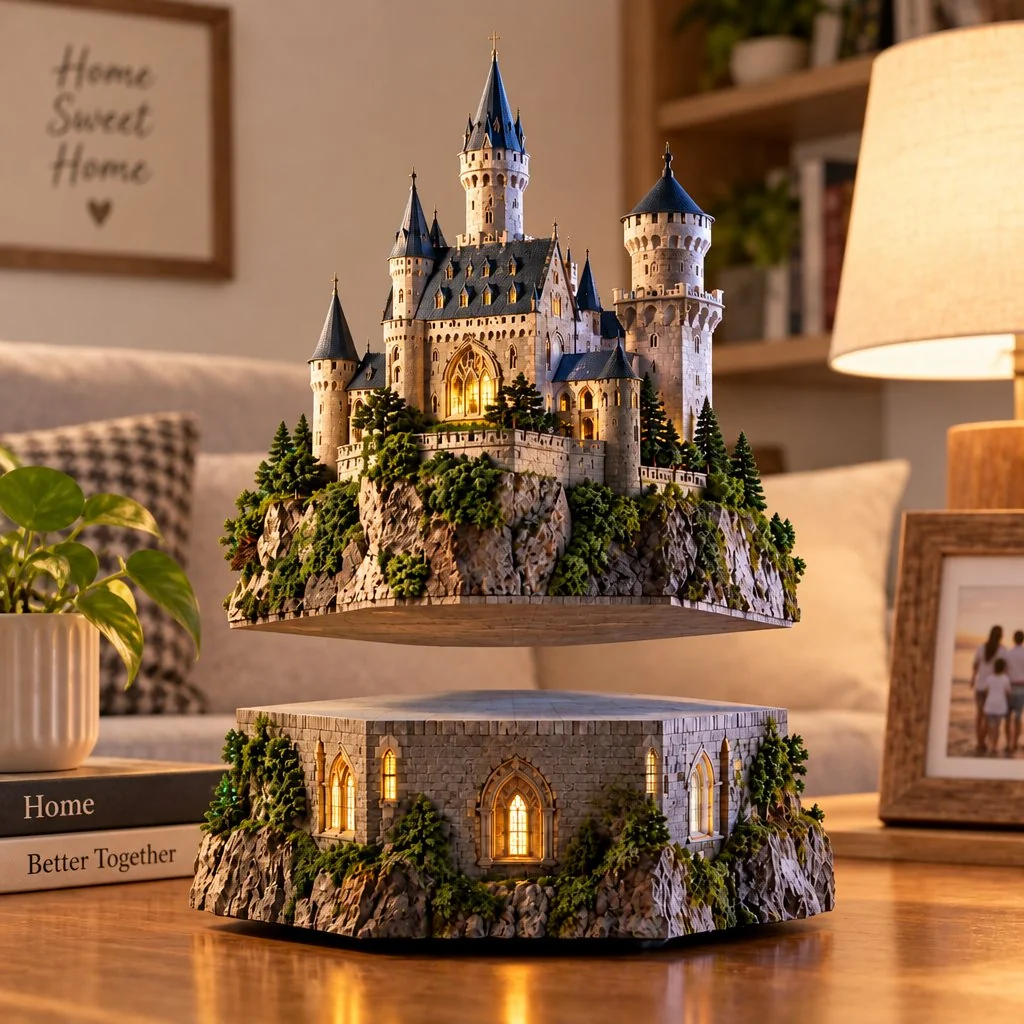
Levitating Castle & Building Model Displays
A fairy-tale castle hanging in mid-air stops people in the doorway. Gleagle PU push-up systems float castles, architecture scale models, pagodas and sky-city builds from 300 g to 3 kg — slow rotation, near-silent, a few watts. Factory-direct OEM/ODM, MOQ 1 pc.
Plan Your Floating ModelConcept build: castle on a floating rock island, PU-class push-up base.
Overview
Castles Are the Perfect Thing to Float
We get this request constantly, and it makes sense. A castle is already a fantasy object — floating it just completes the picture. Architects float scale models to sell a vision. Collectors float sky castles and pagodas. Gift brands sell wooden floating castles by the container. The model is your side of the project; the levitation is ours.
For this kind of display we recommend our PU push-up series: the base sits on the table, the model floats above it, and the whole system runs from a standard wall adapter. Gleagle manufactures the drives in-house (R&D since 2005, 30+ documented design registrations and patent grants, ISO 9001:2015) and ships factory-direct with OEM branding and ODM custom builds. This page covers how to choose the system and how to design the model so it actually flies well.
Applications
Models Customers Ask Us to Float
Fairy-Tale Castles
Castles & Palaces
Neuschwanstein-style builds, fantasy palaces, Ghibli-style sky castles on a rock island. Resin or 3D-printed, typically 200–800 g with lights.
Architecture
Scale & Concept Models
Presentation models for architects and developers — a floating tower makes the pitch unforgettable. Keep the building shell light and low.
Cultural Gifts
Pagodas & Ancient Buildings
Multi-eave pagodas, temples and old-town gatehouses for museum shops and cultural gift lines. Compact footprints float beautifully.
Sky Islands
Floating Islands & Landscapes
The classic "castle in the sky" build — rock island, trees, windows lit from inside. The island base doubles as the perfect place to hide the magnet.
Recommended Systems
Choose by Weight — the PU Push-Up Series
One rule does most of the work: weigh the finished model (with lights and battery), then pick the system whose payload clears it with room to spare.
| System | Max payload | Typical build | Availability |
|---|---|---|---|
| PU300G | 300 g | small castles, pagoda gifts | In stock |
| PU500G | 500 g | medium castles with lighting | In stock |
| PU1000G | 1 kg | detailed castle on a rock island | Ask us |
| PU2000G | 2 kg | large architecture models | Ask us |
| PU3000G | 3 kg | showroom centerpiece builds | Ask us |
Magnet supply is tight this quarter: PU300G and PU500G ship from stock, while PU1000G and larger are built to order — confirm the lead time with us before you promise your client a date.
Design Rules
Three Rules That Decide Whether It Flies
1. Make it light. Price tracks payload hard — each step up the PU ladder roughly doubles the system cost. Hollow prints, foam cores, thin resin shells: every gram you shave off the model is money saved on the drive.
2. Make it small and low. Compact, low builds float steadier because side forces grow fast with height and footprint. Tall, top-heavy towers are the builds that fail. If the design must be tall, widen the stance and hollow the top.
3. Put the magnet under the real center of gravity. Not the geometric center — the physical one. A castle with a heavy rock base has its CG low and often off to one side. Mount the magnet away from that axis and the model spins fast, the drive heats up, and the magnet can eventually work loose.
Same model, two magnet positions. The castle's rock base pulls the true center of gravity low and to one side — mount the magnet at the very bottom of the model, on the CG axis, not in the geometric middle.
The Float Gap
How the Float Gap Is Decided
Two things set the gap: the size of the system and the weight on it. A bigger system holds a higher gap and carries more payload — but the cost climbs much faster than the gap does.
Every Gleagle PU drive runs a slow-servo MID loop. Once your model is loaded, the system automatically searches for its lowest-power hover point and settles the gap right there. That is why our gap numbers are honest: the gap you see on day one is the gap it keeps, drawing very little power to hold it.
The same system floats a heavier model lower — that is physics, not a defect. And one hard limit: models with a high content of ferromagnetic material (steel frames, iron fasteners, magnetic sheet) couple to the field and cannot be stabilized. Resin, PLA, wood, foam and acrylic are all fine.
Get More Air
Want the Maximum Visible Gap?
The visible gap is measured from the base's top surface to the bare magnet on the float. Two moves buy you more of it: step up one system size — the gap grows quickly with system class — and take weight out of the model. Every 100 g you remove buys visible millimeters.
Installation
Installation: Where the Millimeters Hide
Once you have picked a system, the hover gap is fixed — but the visible gap is won or lost in the installation. Three rules:
1. Base below, model above. PU is a push-up geometry: the drive sits on the table and the model floats over it. 2. Keep the base's top shell thin and flat. Any cover thickness or raised bump comes straight out of the viewable gap, so we make the top face as thin and level as the mechanics allow — and you should not add your own cover on top of it. 3. Mount the magnet at the very bottom of the model, on a level plane. A domed, spherical or stepped bottom forces the magnet higher into the model — and eats the gap you paid for.
The visible gap is measured from the base's top surface to the bare magnet on the float. Shell thickness and a curved model bottom both come straight out of it.
Frequently Asked Questions
Can you float my castle or building model?
Almost certainly, if two conditions hold: the model weighs no more than 3 kg, and it contains no large ferromagnetic parts (steel frames, iron screws, magnetic sheet). Resin, PLA, foam, wood and acrylic builds all float well. Send us the weight and footprint and we size the system within 24 hours.
How high will my model float?
The visible gap depends on the system size and the loaded weight. Larger PU systems hold a higher gap with more payload. Every Gleagle PU drive runs a slow-servo MID loop that automatically finds the lowest-power hover point once the model is loaded — so the quoted gap is the gap you actually keep, at very low power.
Can the floating castle have lights inside?
Yes. Small LED strings or window lights in the float usually run on a coin cell or thin lithium cell hidden in the model. Remember to count the battery in your payload budget — lighter model, higher gap.
What happens if the power cuts out?
The float settles gently straight down onto the base. There is no drop, no flip and no damage — the model simply lands and waits for power to return.
Can you build our own castle design as an OEM project?
Yes. We can size a standard PU system for your existing model, or run a full ODM project from sketch to mass production — model, base, lighting and retail packaging. MOQ is 1 pc for standard systems.