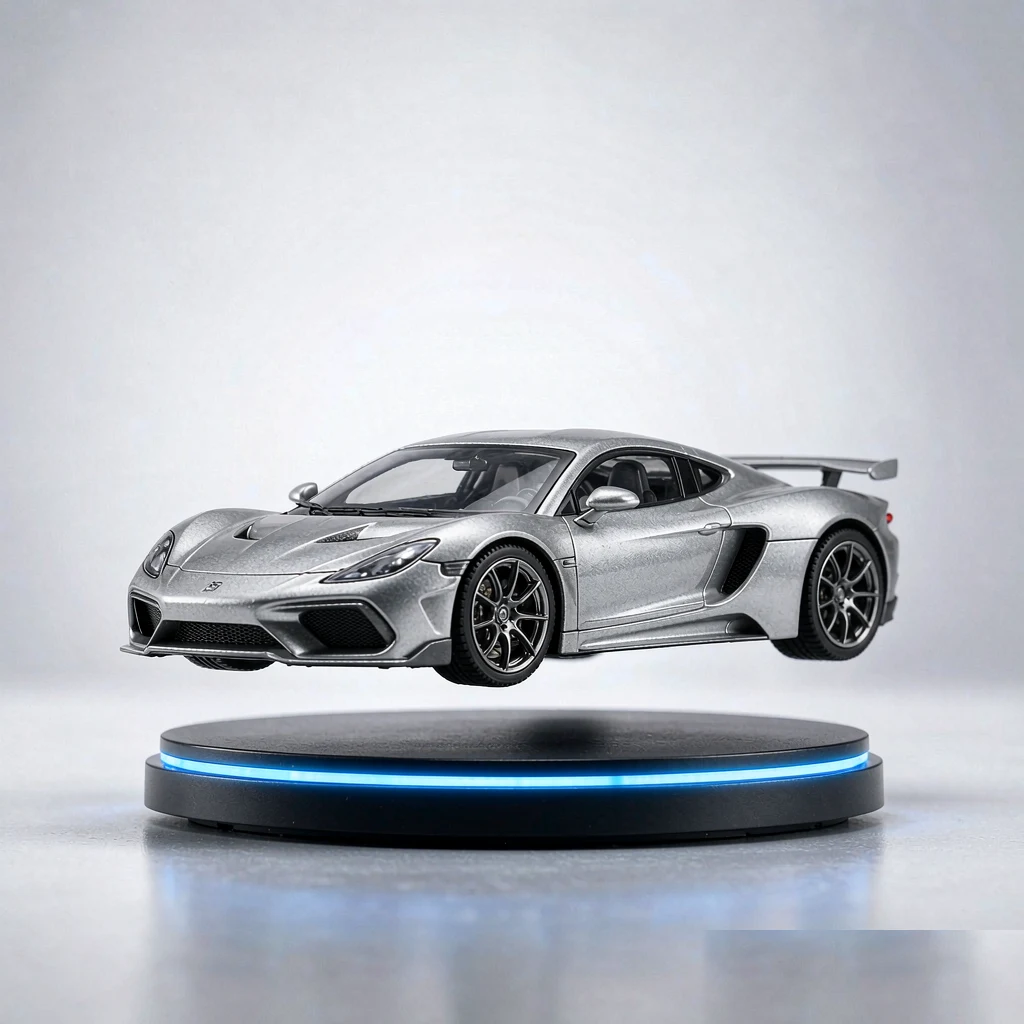
Levitating Car Models — Floating Diecast, Done at Production Grade
A scale car hanging in mid-air — slowly rotating, headlights lit with no battery inside — stops anyone walking past. Gleagle builds levitating car model displays from 1:43 minis to 1:18 heavy diecast, with 29–48 mm of visible air under the car. Factory-direct OEM/ODM, MOQ 1 pc.
Plan Your Floating CarConcept builds: brand launch hero piece, 4S showroom centerpiece, collector edition with wireless-lit headlights.
Why Float a Car
A Parked Model Becomes Invisible. A Floating One Never Does.
A static model shows one angle. After a week on the shelf the eye learns to ignore it. A levitating car rotates slowly and shows every line, forever — that is the whole point of a display.
The gap is the message. Catalog toys hover 9–20 mm — a gap you have to point at. Our PU push-up systems hold 29–48 mm of open air under the car. People see it from across the room.
The lights run on air. Competitors hide a coin cell in the car, or skip the lights. Ours are powered wirelessly through the levitation gap — headlights and taillights that never run out, because there is no battery in the car at all.
Silent by design. Our MID slow-servo holds the car centered with near-zero coil current — the base stays only slightly warm through a full showroom day, and the rotation is a slow drift, not a spin cycle.
Systems
Estimated Float Gap — Same 150 g Car Model on Each System
Every PU system holds the car on a magnetic ring with near-zero holding power; the coils only correct position. A larger system buys a taller gap — the PU3000G reaches 50 mm. Float gap depends on load: around 50% of rated load is the sweet spot for the tallest gap (why that is).
One principle up front: you bring the car model, we engineer everything under it. Your licensed diecast keeps its branding untouched — we design the magnet, the receiver coil and the base around your exact model. (Prefer turnkey? We can source the model too.)
| System | Car model | Visible float gap |
|---|---|---|
| PU300G | 150 g | 15 mm |
| PU500G | 150 g | 29 mm |
| PU1000G | 150 g | 36 mm |
| PU2000G | 150 g | 44 mm |
Estimates measured at the limit mounting position under stress testing — the actual gap on your build depends on how the specific car model is mounted. Heavier customs up to 3 kg run on the PU3000G.
Design Rules
Install Rules That Buy You Visible Gap
1. Mount the magnet at the model's lowest point. Every millimeter between the magnet and the base top is visible daylight. Flush-mount it at the chassis floor — a magnet buried 5 mm up inside the body is 5 mm of gap thrown away.
2. Keep the base top panel thin — 2–3 mm. Panel thickness comes straight out of the float gap. We build our display bases with a 2–3 mm top skin; a chunky 8 mm housing would cost you most of the drama.
3. Magnet under the true center of gravity, not the geometric center. The same rule we give castle builders — a diecast car is tail-heavy, and an off-axis magnet means fast spin and a hot drive. (The castle page draws this out.)
Setup
How to Set It Up — 60 Seconds, No Tools
Set the base on a flat, non-metallic surface and connect the 12 V adapter. A metal table steals the field; wood, glass and stone are fine.
Both hands, car level, directly over the base center. Lower it slowly until you feel the field push back.
At the balance height the car suddenly weighs nothing in your hands. Let go gently — the first time takes about ten seconds of practice.
One touch toggles levitation and rotation. Power cut? The car auto-docks — it settles softly onto the base instead of dropping.
Wireless Power
Wireless LED Headlights — How the Install Works
The levitation gap is not empty — we run power through it. The same wireless power platform behind our levitating light bulbs drives the car's headlights, taillights and interior light bars, with zero battery inside the model.
In the base: a transmitter coil sits under the levitation point, driven at resonance. In the car: a small receiver coil (Ø18–25 mm) hides in the chassis floor, next to the levitation magnet, feeding the LED circuit directly.
The tuning is the product. Every car shape — and every coil position — shifts the resonant frequency. That is why we ask for your actual model: our engineers mount the receiver, place the magnet under the true CG, and tune the system to its lowest power draw and brightest light before anything ships.
Two ways to build: send us your licensed diecast model and we convert it, or we source the model and deliver the whole piece. Logo plate, custom livery and base engraving available on both. See the same wireless platform in our Programmable LED Levitating Display Stand.
See It in Action
Real Builds, Floating on Camera
Three production-grade car models we built and tested in-house — external magnet, internal magnet, and a pull-down build with no base at all.
A fast proof for a US automaker: magnet mounted externally, floating and rotating within minutes.
Watch on YouTubeReceiver coil and magnet hidden inside the chassis — a clean showpiece for a US automaker.
Watch on YouTubeA typical PD pull-down application for a German automaker — no base under the car at all.
Watch on YouTubeWhere It Works
Built for Brands, Showrooms and Collectors
Auto shows & launches — the hero piece on the concept-car podium. We floated a full-size sedan model on the PU2000G for exactly this (see the case).
4S dealerships & showrooms — the current model year, floating at the reception desk. Pair with our automotive showroom displays for a full-floor concept.
Brand merchandise & collector editions — an officially flavored levitating model is the gift tier above the diecast shelf. Anniversary plates, numbered editions, engraved bases.
Museums & motorsport venues — classic liveries floating in the lobby, silent enough for a gallery.
FAQ
Questions Buyers Ask
How does the car float?
A Gleagle PU push-up system: a magnetic ring in the base carries the car's weight passively, while coils inside make tiny corrections to keep it centered. The car holds a fixed height where magnetic force exactly equals its weight — and slow rotation comes free with the field.
Does the car need batteries for the lights?
No. Headlights, taillights and light bars are powered wirelessly across the levitation gap — a transmitter coil in the base, a receiver coil hidden in the chassis. There is no battery in the car, ever.
What happens if the power goes out?
The car auto-docks: as the field fades it settles straight down onto the base and is held by the magnet. No drops, no damage.
Can you float my own 1:18 model?
Yes — that is our most common project. Ship us the model; we weigh it, mount the receiver coil and magnet under its true center of gravity, tune the wireless power, and return a finished floating piece. Heavy diecast up to 1.8 kg runs on the PU2000G; customs to 3 kg on the PU3000G.
MOQ and lead time?
MOQ 1 pc for a sample — test it with your actual car model before committing. Custom builds (livery, logo, engraving, base finish) typically ship in 7–15 business days including prototype approval.