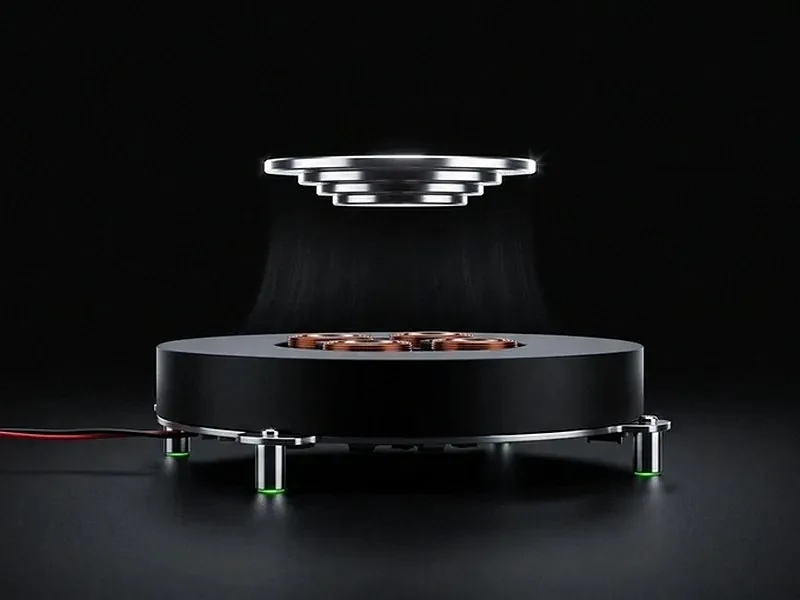
The heavy-duty module in the PU series — 2000g rated, 48mm no-load float gap.
2kg
Rated Load
48mm
No-Load Float Gap
55mm
Extended Float
MID
Slow-Servo · Near-Zero Power
Best Value
In Its Class
2.5kg
Peak Load
Overview
PU2000G Key Specifications
The PU2000G is the heavy-duty module in Gleagle's push-up lineup — 2kg rated, 48mm no-load float gap. Same self-developed control architecture as the 3kg flagship, scaled for large sculptures and premium displays.
Rated Load2000g
Recommended≤ 1kg
No-Load Float Gap48mm (Standard)
Extended55mm
ArchitecturePush-Up
Module InputDC 12V
AC Adapter Input100–240VAC
Plug OptionsEU / US / UK / AU / Other
* Extended float (55mm) requires payload reduction to ~50% of rated max. Measured at 25°C, no-load, tolerance ±1mm.
See It in Action
Watch the PU2000G in action. It provides a 48mm no-load float gap, with height decreasing as payload increases.
Some display pieces are simply heavy — a full-size sculpture, a metal trophy, a product replica, an engineering sample. The PU2000G was built for exactly that range. It supports a rated 2kg payload and provides a 48mm no-load float gap, centers whatever you place on it automatically, and runs 24/7 on a simple DC 12V supply. It covers the heavy end of custom display projects.
2kg rated payload · 2.5kg peak — for large sculptures, trophies, product replicas, heavy samples and premium retail displays
Heavy-duty module in the PU series — bolts into custom bases, plinths and point-of-sale displays
Passive + active hybrid design — the magnet ring carries the load passively on Z with zero holding power; the correction electronics handle only X/Y centering
Slow-servo MID bias system — clamps the coil operating point mid-scale while floating, then drifts it back to zero current when idle — fully in-house slow-servo design
Over-temperature auto-shutoff — on-chip sensor protects the circuitry during continuous operation
Full OEM/ODM — housing, magnet size, float gap, firmware and branding, all customizable
This electromagnetic suspension system requires a little practice to operate — first-time users should practice finding the magnetic balance point. Once mastered, the PU2000G delivers reliable, energy-efficient 24/7 levitation for retail, gifting and exhibition environments.
Please read the operating instructions carefully before first use. Proper handling ensures a successful first levitation and prevents equipment damage.
Mechanical
Dimensions & Mounting
Concentric build: a Ø200 mm steel base plate carries the drive core, with four M3 through holes on the Ø190 mm bolt circle — the module bolts straight into your custom base. All dimensions in millimeters.
Payload
Float Gap (approx.)
No load
48mm
400g
40mm
1kg
25mm
2kg (full load)
Confirmed for your configuration
1. Four M3 through holes on the Ø190 mm bolt circle (90° apart). 2. Tolerances: mounting holes ±0.2mm, other dimensions ±0.5mm, float gap ±1mm (measured at 25°C). The heavier the payload, the narrower the gap — for display pieces where visual height matters, stay within 50% of rated load. STEP files and DXF drawings available on request.
Options
Magnet Configuration Options
Four standard single-disc magnet configurations trade float height against stability and load capacity — heavier objects want a larger diameter, lighter objects can float higher.
STANDARD · MOST STABLE
D100 × 18
48mm
FLOAT GAP
Single disc Ø100 × 18mm
Standard configuration — maximum stability and load capacity, for heavy objects
ALL-ROUNDER
D80 × 15
52mm
FLOAT GAP
Single disc Ø80 × 15mm
The balanced all-rounder — strong stability with a taller float
BALANCED
D70 × 15
55mm
FLOAT GAP
Single disc Ø70 × 15mm
Slimmer magnet, noticeably taller float — for medium payloads
MAX HEIGHT
D60 × 12
55mm+
FLOAT GAP
Single disc Ø60 × 12mm
Smallest magnet, highest float — for light pieces where height matters most
Rule of thumb: the heavier the object, the larger the magnet diameter you need. D100×18 (standard) is recommended for payloads approaching 2kg; D60×12 is for lighter display pieces where float height matters most. Custom magnet configurations on request.
How to Choose the Right Magnet
1. Tall objects, irregular shapes (center of gravity off the geometric center), or payloads over 1 kg — go with the D100 for maximum stability. If magnet size is not a constraint, choose D100 directly — it is the most stable option.
2. Light objects (under 400 g) with regular shapes — spheres, cylinders, square boxes — the D60 works: the smallest magnet in this series, easiest to hide inside your product. The trade-off is lower stability — please test thoroughly and evaluate the risk before ordering.
3. D80 and D70 are the middle grounds — choose mainly by the space available inside your product. Rule of thumb: within the space you have, go as large as you can — a larger diameter means better stability, a wider controlled field area, and a broader sensing range.
Wireless Power Option
If You Need Wireless Power Transmission
Add a spiral planar coil pair: a transmitting (TX) coil in the base and a receiving (RX) coil on the floater. It powers LEDs or other small loads on the floating object — no battery, no wires across the gap. Two placement rules decide how much power you actually get.
TX · BASE SIDE
Transmitting Coil
Mount the transmitting coil directly on the system's magnet ring — flush against it. No standoff, no offset: the coil face sits on the ring.
RX · FLOATER SIDE
Receiving Coil
Mount the receiving coil at the bottom face of the floating magnet — or at minimum, level with the magnet's bottom face. Never recessed above it.
The closer the two coils, the higher the received power — and the brighter your wireless LEDs. Coil distance follows your float gap — see Magnet Configuration Options above.
Wireless power transfer is a complex system that demands extensive testing and tuning. Every product shape — and every coil mounting position — shifts the resonant frequency. Only at the optimal resonance point does the system run at its lowest power draw while delivering maximum received power — and the brightest LEDs. This is precision engineering: if you want the absolute best result, send us your product and our engineers will tune the resonance for you.
Rule of thumb: for display applications where visual height matters, stay within 50% of rated max load. Full specs & pricing: Levitation Modules · Not sure which size? Read the Module Guide
Technology
Flagship Control, Heavy-Duty Build
Like poles repel — the PU2000G turns that one line of physics into a hybrid levitation architecture. A magnet ring carries the load passively on the vertical axis: pure permanent-magnet repulsion, zero circuits, zero power. Active electronics are reserved for the one thing passive physics cannot do — centering. Fully differential sensing channels watch the floater on X and Y, and an in-house slow-servo MID control loop nudges it back before any drift becomes visible.
1. Passive Z Stability
The magnet ring holds the load with zero holding power — physics, not electronics.
2. Differential Sensing
Fully differential X/Y channels cancel thermal drift by construction.
3. Slow-Servo MID Centering
Real-time correction by Gleagle's in-house MID control — centered means zero coil current.
4. Slow-Servo MID Bias
Clamps the operating point under load, drifts back to zero current at idle — standby in the fraction-of-a-watt class.
Ultra-Low Power by Architecture, Not by Throttling
Moving a 2kg payload means real energy in the field — generic heavy modules fight the heat by throttling power, which costs you float height and stability. The PU2000G barely makes heat in the first place: the load rides passively on the magnet ring, so the coils draw current only while correcting — and sit at zero current once centered. Static draw stays in the fraction-of-a-watt class, roughly a fifth of pull-up designs. Less power in means less heat out: the module runs cool through 24/7 retail operation, without giving up its 48mm no-load float gap.
Everything is developed in-house: PCB design, control circuitry, magnetics and coil winding, by Gleagle's 15+ R&D engineers. No outsourced core technology.
Large sculptures, trophies, product replicas, premium retail displays
1. Levitation height tolerance: ±1mm. 2. Maximum height is measured under no-load conditions at 25°C. 3. Height decreases as payload increases — confirmed reference points are 48mm at no load, 40mm at 400g and 25mm at 1kg; the full 2kg gap is configuration-specific.
Detailed mechanical specifications — base dimensions, mounting patterns, power draw and integration guidelines — are available in our engineering datasheet. Request the complete technical package →
Guide
Operating Instructions
From the official Gleagle user manual. A few attempts and you will find the balance point with ease.
1
Set Up the Base
Place the base on a flat surface free from ferromagnetic materials. Connect the DC 12V adapter and turn on the power.
2
Find the Balance Point
Hold the magnet disc over the base at about 15cm (6 inches), aligned with the center. Slowly move it downward — the balance point sits approximately 48mm above the base surface.
3
Release Gently
When the magnet feels almost weightless — neither falling nor pushed away — release it gently. If it falls, start over from Step 2.
4
Place Your Object
Once the disc floats stably, gently place your object on it, centered vertically. If the disc drops, protect the base with foam padding and try again.
— From the User Manual: TIPS It might require some practice to operate correctly initially. Do not be discouraged; try again. You will soon find the balance point with ease.
The magnet disc may detach and strike the base forcefully — consider placing a soft plate on the base while practicing. Auto-shutoff: the built-in temperature sensor cuts power if the base exceeds the safety threshold. If levitation fails after several attempts, wait at least one minute before retrying.
OEM / ODM
Custom Levitation Module Development
From concept to mass production — tailored to your product.
How to Customize
①
Share Product Details
Provide object weight, dimensions, and material. Product photos are highly recommended for accurate assessment.
②
Describe Desired Effect
How should the object levitate? Target float gap, orientation, and any structural or aesthetic constraints.
③
Solution & Proposal
Gleagle engineers evaluate feasibility and deliver an actionable solution with architecture recommendation.
④
Sample & Mass Production
Prototype validation, calibration sign-off, then full production with 100% burn-in testing.
Ordering Information
Flexible terms for projects of any scale — from prototype to production.
1 PC
Minimum Order
As Fast as 24 Hours
Lead Time
Sample Orders Welcome
Samples
T/T Bank Transfer
Payment
Support
Frequently Asked Questions
Does the PU2000G work with 110V, 120V, 220V and 230V mains power?
Yes. The supplied wide-input AC adapter accepts 100–240VAC, covering common 110/120V and 220/230/240V mains supplies. No separate voltage converter is needed. The adapter supplies DC 12V to the module. Select the correct country-specific plug (EU, US, UK, AU or another local type) when ordering. Find your country's plug type →
What is the maximum weight the PU2000G can levitate?
2kg rated, 2.5kg peak. For the best visual height and long-term stability we recommend staying within 1kg — roughly the 50% load rule. The 48mm figure is measured at no load; reference measurements are 40mm at 400g and 25mm at 1kg. The extended configuration reaches 55mm at reduced payload.
What kinds of products is the PU2000G best for?
Anything regular-shaped, non-ferromagnetic and up to 2kg — large sculptures, metal trophies, product replicas, engineering samples and premium decor. It is the module behind our heaviest levitating display projects.
How is the PU2000G different from the smaller PU modules?
Same control architecture — in-house slow-servo MID control with near-zero power draw — scaled up for heavy payloads and a 48mm no-load float gap. For lighter objects see the PU300G and PU500G; for even heavier loads, the 3kg PU3000G flagship.
Module or finished product — which do I need?
The PU2000G is the bare levitation module: you integrate it into your own base, packaging or product. If you want a ready-to-use display out of the box, look at our finished products — for example the Programmable LED Levitating Display Stand, which adds world-exclusive wireless LED lighting to the same push-up platform.
Can I order a single sample?
Yes. MOQ is 1 unit for the standard PU2000G. Evaluation samples can ship as fast as 24 hours via DHL/FedEx/UPS. We encourage testing a sample with your actual product before placing bulk orders.
Do you offer OEM/ODM customization?
Yes — magnet disc size, float gap, load tuning, coil winding, housing, PCB layout, firmware and branding. Custom projects typically require 7–15 business days, depending on complexity and the agreed production scope.
What certifications does the PU2000G have?
Gleagle is ISO 9001:2015 certified. Available compliance documents depend on the exact module, configuration and destination market; please confirm the applicable documents before ordering, and each unit undergoes burn-in testing before shipment with individual calibration. Third-party factory inspection is accepted.
Does the 2kg payload rating include the floating magnet?
No. The 2kg rating refers to the display object and does not include the floating magnet. Send both the object weight and your preferred magnet configuration so we can check the complete setup.
Can I float an object containing electronics or a speaker magnet?
Use caution. Ferromagnetic housings and additional permanent magnets — including speaker magnets — can disturb levitation. Strong magnetic fields may also damage sensitive electronics. Compatibility depends on the complete assembly, so an actual prototype test is required before production.
How should I position the center of gravity, and will the object keep a fixed orientation?
Keep the center of gravity aligned with the object's geometric center and the system's vertical axis. An off-center load can tilt, rotate too fast or fall. Rotation is not actively controlled, so a fixed orientation cannot be guaranteed; a balanced, regular shape gives the best chance of a near-still display.
What float gap can I expect with a 1kg object?
Our reference configuration measures 25mm at 1kg. Final height still depends on magnet size, object shape, center of gravity and assembly, so we confirm it using the actual object or a representative prototype.
What happens to the floating object during a power outage?
The floater will drop onto the base when power is lost. Add a protective pad or enclosure, and design the display so the falling object cannot be damaged.
Can the PU2000G provide wireless power to the floating object?
Yes, as a custom engineering project rather than a standard PU2000G feature. Continuous output depends on the receiving coil area, working gap and electrical load. Provide your required DC voltage and continuous power in watts for a feasibility review and separate quotation.
Can you ship internationally, and are import duties included?
Yes. A full delivery address and postcode are required to calculate freight. Samples normally ship DAP, so import duties, taxes and local clearance charges are not included. DDP can be requested where available and is quoted separately.
Safety
Safety Warnings & Prohibitions
⚠ Warning
The base and floating magnet produce strong magnetic forces that can attract nearby metallic items such as blades or scissors — keep them away during operation.
Do not drop, strike, or shake the product aggressively; such actions may damage internal components and void the warranty.
Children under 18 must not operate this device due to the strong magnetic forces involved.
For indoor use only. Always protect your hands during operation.
🚫 Prohibition
Do not leave the floating magnet attached to the base when not in use — it may magnetize internal components and void the warranty.
Ferromagnetic or magnetic objects are prohibited from levitating. Do not levitate objects containing iron, or electronic devices that may be damaged by strong magnetic fields.
Need a Heavy-Duty Levitation Module?
Share your product — we'll confirm fit and propose an optimized configuration within 24 hours.
From Our Inbox: Customer Questions
Q"I want to float a 1.5kg metal trophy — which magnet should I choose?"— Mr. R., United Kingdom
AAt 1.5 kg you go straight to the D100 × 18 standard configuration — the larger magnet keeps heavy, top-heavy objects noticeably more stable. Expect a float gap around 22–25mm at that payload. If the trophy can be lightened toward 1 kg, the gap opens up to roughly 25mm and the display looks much better. If you are not sure, send us the figure’s weight and dimensions and we will confirm the configuration before you order. — Mr. Luo, Chief Engineer, Levitation Systems
Q"Can the rotation be controlled precisely?"— Mr. K., Japan
ANot by the base — and that is by design. The magnetic field is rotationally symmetric, like a frictionless perfect bearing: it neither drives nor brakes the spin. But the object you place decides 90% of it — center the weight and use regular shapes for a near-still display, or keep a touch of deliberate asymmetry for a slow, elegant rotation. Full explanation with tuning tips: Why Does It Spin? Rotation in PU Levitation Systems, Explained →— Mr. Luo, Chief Engineer, Levitation Systems
Get Your Custom Quote
Reference Price: US$218.00 / pc at 100 pcs · Base configuration · EXW
Contact our sales team for more configurations and preferential pricing.
Request a PU2000G Quote
Worldwide power: the included wide-input adapter accepts 100–240VAC. It works with 110/120V and 220/230/240V mains without a separate voltage converter. Select your local plug below.