The symptom: your PD levitation system floats the product perfectly — then, after minutes of running, the floater suddenly drops, or snaps upward against the drive core. Based on the customer cases we handle, this is almost always an installation or setup issue, not a defective unit — and you can usually diagnose it in about ten minutes. This guide walks you through it.
Quick background: how a PD system holds balance
A PD (pull-down) system hangs the floater below the drive core and holds it against gravity with a precision servo loop: position sensors watch the floater thousands of times per second, and the controller adjusts coil current to keep the gap constant. It is a classic slow-servo, high-precision mechanism — which is why it is sensitive to two things above all: how much weight it carries, and how level it sits. (For the full physics, see Levitation as a Controlled State.)
Weight compatibility: the windows our production line has measured
Every PD system is calibrated for a rated payload, with a working window around it. These figures come from years of production-line measurement, not theory:
| System class | Stable compatibility | Example |
|---|---|---|
| Light payload (up to 100 g) | ±5% | Rated 100 g → stable from 95–105 g |
| Mid payload (100–300 g) | ±10% | Rated 200 g → stable from 180–220 g |
| Heavy payload (above 300 g) | ±20% | Rated 1000 g → reference window 800–1200 g, subject to factory calibration |
Two practical notes:
- Systems above 300 g use an approximately ±20% reference window; the final range is confirmed during factory calibration.
- Adjustable PD systems ship with an LCD interface — you can re-set the load range to match your exact product weight from the menu.
What actually happens before the drop: the overheat chain
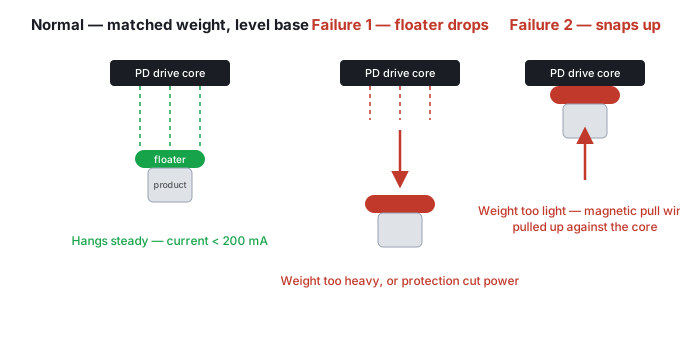
When the weight is outside the matched window — or the drive core is not level — the floater sits off the magnetic center. The servo loop never finds a stable point, so it hunts: high-frequency corrections, all the time, at high current. The driver transistors and coils heat up, and the temperature keeps climbing. A healthy, matched system warms to about 55°C during catch-and-lock, then eases back to roughly 40°C once floating steadily. A mismatched system never gets the chance: its temperature climbs past the ~72°C threshold, and the thermal sensor cuts power to protect the unit. Levitation ends instantly — the floater drops or snaps up.

Step-by-step diagnosis
Step 1 — Check that the drive core is level
Magnetic levitation fights gravity with a precision servo, so it is demanding about levelness. If the drive core is installed at a tilt, the magnetic poles tilt with it, and the loop must correct continuously at high frequency — more current, more heat. Field rule from our production experience: the tilt must stay within 10°, and ideally within 5° — the 5° zone is the threshold for entering true ultra-low-power operation. Use a spirit level if you have one.
Step 2 — Re-weigh your product (net weight, without the magnet)
The rated payload never includes the floating magnet — it is already counted in the system design. The single most common mistake we see: customers weigh the product with the magnet attached. Use a scale with 10 g accuracy or better (many kitchen and luggage scales drift far more than they claim); our factory calibrates at 1 g.
Step 3 — Check the floater’s balance after mounting
With irregular-shaped products, the mounting point may not sit over the center of gravity. The floater then hangs tilted, the magnetic axis shifts, and the sensor readings go off — which leads to exactly the same high-current hunting as Step 1. Field rule: once floating, the magnet’s tilt should stay within about 10°; within 30° of product tilt is usually fine. If yours sits at an odd angle, send us a short video and we will confirm.
Step 4 — Read the failure direction
- It drops: your product is probably too heavy — the magnetic pull can no longer hold it against gravity.
- It snaps up: your product is probably too light — the pull wins and draws the floater up against the core.
Note: this is a field rule, not a 100% criterion — in unstable cases where the floater bounces up and down before failing, the direction can be ambiguous. Use Step 5 to be sure.
Step 5 (optional, decisive) — Watch the current
If you have a current meter, this settles the question. You can ignore voltage — our systems accept 11–18 V. Watch current instead, with no extra load attached (no fan, no LED):
- A matched weight draws under 200 mA once floating — often under 100 mA. That is the ultra-low-power design point.
- Right after catch, current should be below 500 mA; after ten seconds or so the auto-tuning phase pulls it down to the minimum.
- If current exceeds 500 mA from the moment it floats, the load is beyond the maximum adjustment range. The loop enters a sustained high-current unstable state, the transistors and coils keep heating, and the thermal sensor will cut power — drop or snap-up follows.
The fix checklist
| Action | Priority |
|---|---|
| Level the drive core — within 10° maximum, aim for 5° (spirit level recommended) | Required |
| Re-weigh the product net, without the magnet, on a scale with 10 g accuracy or better | Required |
| Make sure the floater hangs within 10° of level once floating (check mounting point vs. center of gravity) | Required |
| Re-set the load range on the LCD interface to your measured net weight (adjustable PD models) | Required if adjustable |
| Observe current if you can: steady-state under 200 mA within ~10 s of floating, no fan/LED attached | Optional |
Still not solved?
Submit a support ticket — and if possible attach or email us a photo of your installation and a short video of the behavior (to support@gleaglegroup.com). Our engineering team handles these one-on-one, and with the footage we can usually pinpoint the cause in one reply.
Frequently asked questions
- It floats fine at first, then drops after a few minutes. Why? The loop is over-correcting and overheating — weight outside the matched window or an unlevel core causes high-current hunting until the thermal sensor cuts power. Re-weigh (net, no magnet), level the core, and re-set the load range on the LCD.
- How do I know if my product is too light or too heavy? Drops usually mean too heavy (gravity wins); snap-ups usually mean too light (magnetic pull wins) — but bouncing failures can be ambiguous. The decisive check is current: matched systems settle under 200 mA; sustained draw above 500 mA means the load is outside the adjustment range.
- Should I weigh the product with the magnet attached? Never — the rated payload is net product weight only. That is the most common setup mistake we see. Use a 10 g-accuracy scale; our factory calibrates at 1 g.
- How level does the drive core need to be? Within 10° at most, ideally within 5°. Beyond that, constant high-frequency correction defeats the ultra-low-power design and builds heat.
- What weight tolerance do PD systems have? Production reference: approximately ±5% up to 100 g, ±10% for 100–300 g, and ±20% above 300 g. Final tolerance depends on factory calibration. Adjustable models re-set via the LCD interface.
Related reading: Levitation as a Controlled State · Why Does It Spin? Rotation in PU Levitation Systems · Technology Q&A